Networking Training Course in Kolkata & Live Online

Networking Training in Kolkata – Classroom & Live Online Training

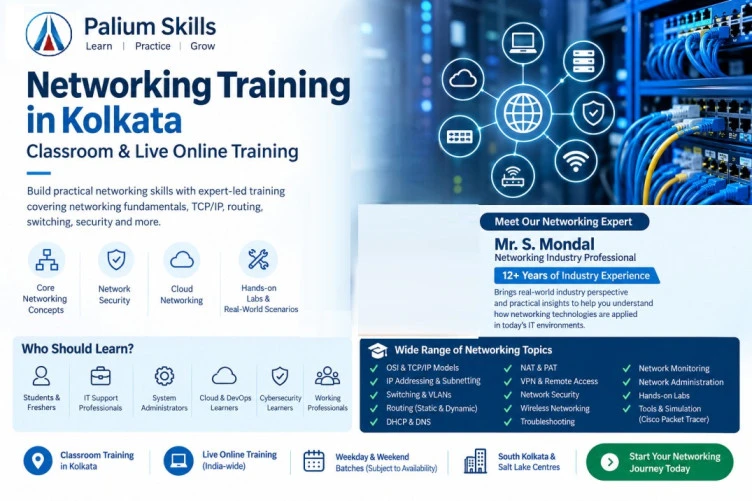
Build practical networking skills with Networking Training at Palium Skills, designed for students, IT professionals, job seekers and working professionals who want to understand computer networks, network infrastructure, protocols, security and troubleshooting. The program covers networking fundamentals through advanced concepts including TCP/IP, OSI Model, IPv4/IPv6, subnetting, routing, switching, VLANs, DNS, DHCP, NAT, VPN, network security, wireless networking, troubleshooting and network administration. Training is available through classroom sessions in Kolkata and live online instructor-led training across India, with practical examples and hands-on learning focused on real-world networking environments.

Networking Training at Palium Skills

Computer networking is a fundamental part of modern IT infrastructure. Organizations depend on reliable networks for communication, cloud applications, enterprise systems, cybersecurity, remote access and business operations. Our networking-oriented training helps learners develop an understanding of how networks are designed, configured, monitored, secured and troubleshot. The program can be useful for:
  • Students starting a career in networking and IT infrastructure
  • IT support and technical support professionals
  • System administrators
  • Network administrators
  • IT infrastructure professionals
  • Cloud and DevOps learners
  • Cybersecurity learners
  • Working professionals upgrading their networking knowledge
  • Candidates preparing for networking-related roles and certifications
 

Networking and Cloud Computing

Modern infrastructure increasingly combines traditional networking with cloud platforms. The networking foundation developed through this training can support further learning in areas such as:
  • Cloud networking
  • Virtual networks
  • Subnets
  • Security groups
  • Load balancing
  • VPN connectivity
  • Hybrid networking
  • Network security
  • Cloud infrastructure
This foundation can be particularly useful for learners progressing toward cloud administration, DevOps or cybersecurity.

Networking and Cybersecurity

Networking knowledge is also important for understanding cybersecurity. Learners can build foundational knowledge relevant to:
  • Network security
  • Firewalls
  • VPNs
  • Access control
  • Network segmentation
  • Secure protocols
  • Traffic analysis
  • Security monitoring
  • Incident investigation fundamentals
A strong understanding of normal network behaviour helps professionals identify and investigate unusual network activity.

Faculty is Networking Industry Expert

Mr. S. Mondal — Networking Industry Professional

12+ Years of Industry Experience in Networking The Networking training at Palium Skills is supported by Mr. S. Mondal, an experienced networking industry professional with 12+ years of industry experience in the networking domain. His professional experience brings practical industry perspective to networking concepts, helping learners understand how networking technologies and infrastructure concepts are applied in real-world IT environments. Mr. S. Mondal's industry-oriented approach supports practical understanding of areas such as:
  • Computer networking fundamentals
  • TCP/IP networking
  • IP addressing and subnetting
  • Routing and switching concepts
  • VLANs
  • Network troubleshooting
  • Network administration
  • Network security fundamentals
  • Enterprise networking concepts
  • Practical network infrastructure
  • Multiple Certifications from CCNA, Azure & AWS
The focus is on helping learners connect networking theory with practical workplace requirements and develop a structured approach to understanding, configuring and troubleshooting network environments.

Experience-Based Learning

With 12+ years of industry experience in networking, Mr. S. Mondal brings real-world professional perspective to the training. The program focuses on:
  • Practical networking concepts
  • Industry-oriented examples
  • Troubleshooting approaches
  • Hands-on learning
  • Real-world network scenarios
  • Structured problem solving
  • Professional networking skills
This experience-based approach helps learners understand not only what a networking technology does, but also where and why it is used in an IT environment.

Who Should Learn Networking?

Networking training can be useful for:

Students and Freshers

Build a foundation in computer networking before entering IT infrastructure, technical support, cloud or cybersecurity roles.

IT Support Professionals

Develop stronger networking knowledge for diagnosing connectivity, DNS, DHCP, IP addressing and other common infrastructure issues.

System Administrators

Strengthen understanding of routing, switching, network services, security and troubleshooting.

Cloud Professionals

Build the networking foundation required for understanding cloud networks, subnets, routing, VPNs and hybrid infrastructure.

Cybersecurity Learners

Develop networking fundamentals that support further study of network security and cybersecurity.

Working Professionals

Upgrade networking knowledge to support career development and transition into infrastructure-oriented roles.

Prerequisites

The course is suitable for learners with basic computer knowledge. Prior professional networking experience is not mandatory for the beginner-level concepts. A basic understanding of:
  • Computers
  • Operating systems
  • Internet usage
  • Basic command-line operations
can be helpful. Learners with existing IT experience can progress directly to the topics relevant to their professional requirements.

Networking Learning Path

A structured networking learning path can be: Computer FundamentalsNetworking FundamentalsOSI & TCP/IPIP Addressing & SubnettingSwitching & VLANsRoutingNetwork ServicesNetwork SecurityTroubleshootingCloud / Cybersecurity / Network Administration This progression allows learners to build networking knowledge systematically.

Career Areas Supported by Networking Skills

Networking knowledge can be relevant to roles and career paths such as:
  • Network Support Engineer
  • Network Administrator
  • IT Support Engineer
  • System Administrator
  • Infrastructure Support Professional
  • NOC Engineer
  • Network Operations Professional
  • Cloud Support Professional
  • Cybersecurity Support Professional
  • Technical Support Engineer
Specific job requirements vary by employer, technology environment and experience level.

Classroom and Live Online Networking Training

Palium Skills provides flexible learning options for networking-related training.

Classroom Training

Instructor-led classroom training is available in Kolkata, with practical explanations, demonstrations, exercises and opportunities to discuss networking concepts with the trainer.

Live Online Training

Learners outside Kolkata can participate through live online instructor-led sessions. The online format can include:
  • Live trainer interaction
  • Screen demonstrations
  • Practical exercises
  • Assignments
  • Doubt clarification
  • Learning resources

Networking Training in Kolkata

Palium Skills offers networking-related training for learners in Kolkata, including participants from South Kolkata and Salt Lake/Sector V. The training is designed for students, freshers, IT professionals and working professionals seeking practical networking knowledge.  

Why Learn Networking with Palium Skills?

Palium Skills combines structured technical learning with practical, industry-oriented instruction. Key features include:
  • Experienced networking industry professional
  • Mr. S. Mondal — 12+ years of networking industry experience
  • Practical networking concepts
  • Real-world scenarios
  • Hands-on exercises
  • Troubleshooting-oriented learning
  • Classroom training in Kolkata
  • Live online training
  • Weekday and weekend options, subject to batch availability
  • Learning support and doubt clarification
  • Networking foundation for cloud and cybersecurity learning

Related Courses

The courses related to this are -
Networking Course Topics

1. Introduction to Computer Networking

Understand the fundamentals of computer networks and how devices communicate. Topics include:
  • What is computer networking?
  • LAN, WAN, MAN and PAN
  • Network topologies
  • Network devices
  • Client-server and peer-to-peer networks
  • Network architecture
  • Bandwidth, latency and throughput
  • Unicast, multicast and broadcast
  • Network communication basics

2. OSI Model

Learn the seven-layer OSI reference model and understand the role of each layer. Topics include:
  • Physical Layer
  • Data Link Layer
  • Network Layer
  • Transport Layer
  • Session Layer
  • Presentation Layer
  • Application Layer
  • Encapsulation and decapsulation
  • OSI troubleshooting approach

3. TCP/IP Model

Understand the TCP/IP architecture used in modern computer networks. Topics include:
  • TCP/IP model
  • TCP and UDP
  • IP addressing
  • Ports and sockets
  • Application protocols
  • Packet transmission
  • Connection-oriented and connectionless communication

IP Addressing and Subnetting

IP addressing is a core networking skill. Learners will understand how IPv4 and IPv6 addresses are structured and used. Topics include:
  • IPv4 addressing
  • IPv6 fundamentals
  • Public and private IP addresses
  • Network and host portions
  • Subnet masks
  • CIDR notation
  • Default gateway
  • Network address
  • Broadcast address
  • Host ranges
  • Subnetting
  • VLSM concepts
  • Basic subnet calculations
Practical subnetting exercises can help learners develop confidence in designing and analysing IP networks.

Ethernet and Switching

Learn how switches operate within local area networks. Topics include:
  • Ethernet fundamentals
  • MAC addresses
  • Switch operation
  • MAC address tables
  • Collision and broadcast domains
  • Layer 2 switching
  • VLANs
  • Access ports
  • Trunk ports
  • Inter-VLAN communication
  • STP fundamentals

Routing

Understand how traffic moves between different networks. Topics include:
  • Routing fundamentals
  • Routing tables
  • Static routing
  • Default routing
  • Dynamic routing concepts
  • Administrative distance
  • Metrics
  • Inter-network communication
  • Routing troubleshooting
The program can introduce common routing protocols and their practical purpose, including:
  • RIP
  • OSPF
  • EIGRP concepts
  • BGP fundamentals

VLAN and Network Segmentation

Learn how VLANs can be used to logically separate network traffic. Topics include:
  • VLAN concepts
  • VLAN configuration principles
  • Access and trunk ports
  • 802.1Q tagging
  • Native VLAN concepts
  • Inter-VLAN routing
  • Network segmentation
  • Broadcast-domain control

DHCP

Understand automated IP address allocation and network configuration. Topics include:
  • DHCP operation
  • DHCP Discover
  • DHCP Offer
  • DHCP Request
  • DHCP Acknowledgement
  • DHCP scopes
  • Reservations
  • Lease management
  • DHCP relay concepts
  • Common DHCP troubleshooting

DNS

Learn how domain names are translated into IP addresses and how DNS supports network applications. Topics include:
  • DNS fundamentals
  • DNS hierarchy
  • Domain names
  • Name resolution
  • DNS records
  • A and AAAA records
  • CNAME
  • MX
  • NS
  • PTR
  • Forward and reverse lookup
  • DNS troubleshooting

NAT and PAT

Understand how private networks communicate with external networks. Topics include:
  • Network Address Translation
  • Static NAT
  • Dynamic NAT
  • PAT
  • Private and public addressing
  • NAT use cases
  • Common NAT troubleshooting scenarios

Network Security Fundamentals

Develop an understanding of the security principles used to protect network infrastructure. Topics include:
  • Network security fundamentals
  • Firewalls
  • Access control
  • Network segmentation
  • Secure remote access
  • VPN concepts
  • Authentication and authorization
  • Common network threats
  • Secure network practices
  • Basic security monitoring

VPN and Remote Connectivity

Understand how users and systems can securely connect to remote networks. Topics include:
  • VPN fundamentals
  • Remote-access VPN
  • Site-to-site VPN
  • Encryption concepts
  • Tunnelling
  • Secure remote connectivity
  • VPN troubleshooting

Wireless Networking

Learn the fundamentals of wireless network infrastructure. Topics include:
  • Wi-Fi fundamentals
  • Wireless standards
  • Access points
  • SSID
  • Wireless authentication
  • Wireless security
  • 2.4 GHz and 5 GHz concepts
  • Channel interference
  • Wireless troubleshooting
  • Enterprise wireless networking concepts

Network Troubleshooting

Troubleshooting is one of the most important practical networking skills. Learners can develop a structured approach to identifying and resolving network problems. Topics include:
  • Connectivity troubleshooting
  • IP configuration problems
  • DNS problems
  • DHCP problems
  • Routing issues
  • VLAN issues
  • Gateway problems
  • Packet-loss analysis
  • Latency analysis
  • Network configuration errors
  • Basic network monitoring
Common tools and commands include:
  • Ping
  • Tracert / Traceroute
  • Ipconfig / Ifconfig
  • Nslookup
  • Netstat
  • ARP
  • Route
  • Pathping
  • Basic packet-analysis concepts

Network Monitoring and Administration

Understand the basic principles of monitoring network availability and performance. Topics include:
  • Network monitoring
  • Availability monitoring
  • Performance monitoring
  • Bandwidth monitoring
  • Device monitoring
  • Logs and alerts
  • SNMP fundamentals
  • Network documentation
  • Configuration management
  • Basic network administration

Practical Networking Exercises

The training is designed around practical understanding rather than memorising networking terminology. Depending on the selected training format and lab environment, practical exercises can include:
  • Designing a small LAN
  • IP addressing exercises
  • Subnetting exercises
  • Switch configuration concepts
  • VLAN implementation
  • Inter-VLAN routing
  • Static routing
  • DHCP configuration
  • DNS troubleshooting
  • NAT configuration concepts
  • Network connectivity troubleshooting
  • Network security scenarios
  • Wireless networking scenarios
  • Network documentation

Networking Tools and Lab Practice

Networking concepts become easier to understand when learners can observe how devices communicate. Practical learning may involve networking simulation and lab environments for:
  • Network topology design
  • Router and switch concepts
  • IP addressing
  • VLANs
  • Routing
  • Troubleshooting
  • Packet flow analysis
  • Network configuration practice
Where applicable, learners can work with network simulation tools such as Cisco Packet Tracer and other suitable lab environments.

Contact Palium Skills

For networking training enquiries, batch schedules and course details: Palium Skills South Kolkata Center: 1st Floor, Sheeba Bhavan, 1/22 Poddar Nagar (Near South City Mall), Kolkata – 700068 Salt Lake Center: 5th Floor, RDB Boulevard, Block GP, Salt Lake Electronic Complex, Kolkata – 700091 Contact: 8420594969 / 7044871915 WhatsApp: 9903130500 Email: info@paliumskills.com Classroom & Live Online Networking Training | Kolkata & India
Course NameDelivery ModeFeeSpecial Offer
Networking Beginners to AdvancedClassroom/ Live Online/ Hybrid₹25,000Duration: 24 hours (12 sessions x 2 hours each)
Networking Training Course for CorporatesClassroom/ Live Online/ HybridContact UsTo be discussed

Computer networking is the process of connecting computers, servers, network devices and other systems so that they can communicate and share resources.

Networking can initially involve unfamiliar concepts such as IP addressing, subnetting, routing and protocols. A structured learning path and practical exercises can make these concepts easier to understand.

The curriculum can cover networking fundamentals, OSI and TCP/IP models, IP addressing, subnetting, routing, switching, VLANs, DNS, DHCP, NAT, VPN, wireless networking, security and troubleshooting.

No. Beginners can start with fundamental networking concepts. Learners with previous IT experience can use the program to strengthen their existing knowledge.

Yes. IP addressing, subnet masks, CIDR and subnetting concepts are important parts of networking fundamentals.

Yes. The curriculum covers routing and switching concepts, including VLANs, routing tables, static routing and dynamic-routing fundamentals.

Yes. The program introduces fundamental network security concepts including firewalls, VPNs, access control, segmentation and secure networking practices.

Yes. Palium Skills provides live online instructor-led training in addition to classroom training in Kolkata.

Yes. Networking fundamentals are useful for understanding cloud networking concepts such as virtual networks, subnets, routing, VPNs and hybrid connectivity.

Yes. Networking fundamentals provide an important foundation for understanding network security, traffic analysis, firewalls, secure connectivity and other cybersecurity concepts.

A Few Things You’ll Love!

  • Experienced Training Partner
  • Certified & Industry Expert Trainers
  • Multiple Training Delivery Models
  • Customized
    Course
  • 24/7 e-Learning Access
  • Assessments and Mock Tests
  • Placement Assistance
Training Calendar
Whatsapp Logo