Ultrasonic Testing Course Syllabus
Module 1: Fundamentals of Ultrasonic Testing
The course begins with the basic scientific principles required to understand ultrasonic inspection.
Topics include:
- Introduction to Non-Destructive Testing
- Introduction to Ultrasonic Testing
- Principles of ultrasonic inspection
- Mechanical waves
- Longitudinal waves
- Shear waves
- Surface waves
- Frequency
- Wavelength
- Velocity
- Period
- Amplitude
- Acoustic impedance
- Reflection
- Refraction
- Diffraction
- Attenuation
- Scattering
- Absorption
- Beam spread
- Near field
- Far field
- Sound transmission through materials
Module 2: Ultrasonic Waves and Material Properties
Understanding the interaction between ultrasonic waves and materials is essential for effective UT inspection.
Topics include:
- Sound velocity
- Material properties
- Acoustic impedance
- Reflection coefficients
- Transmission
- Refraction
- Critical angles
- Mode conversion
- Attenuation
- Grain structure
- Material thickness
- Surface condition
- Effect of geometry on ultrasonic inspection
Module 3: Ultrasonic Testing Equipment
Participants are introduced to commonly used UT inspection equipment.
Topics include:
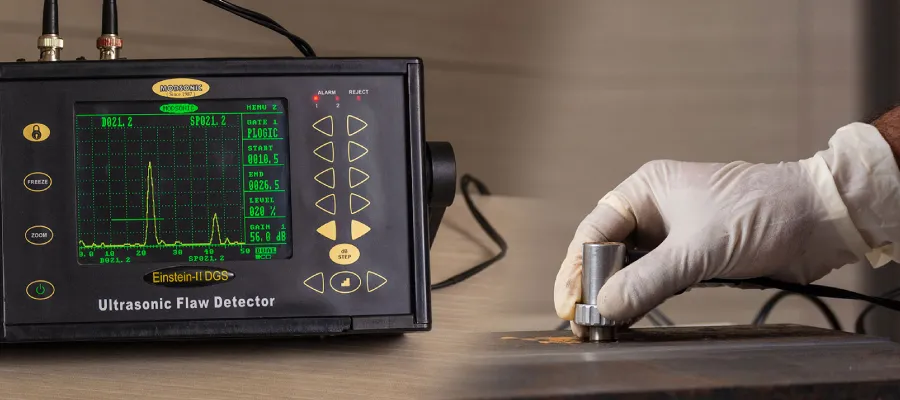
- Ultrasonic flaw detectors
- Digital ultrasonic instruments
- Thickness gauges
- Display systems
- Transducers
- Probes
- Probe cables
- Couplants
- Reference blocks
- Calibration blocks
- Equipment controls
- Gain
- Range
- Delay
- Reject
- Frequency selection
Module 4: Ultrasonic Probes and Transducers
Probes are critical components of ultrasonic inspection.
Topics include:
- Straight-beam probes
- Angle-beam probes
- Dual-element probes
- Single-crystal probes
- Dual-crystal probes
- Contact probes
- Immersion probes
- Probe frequency
- Probe size
- Probe angle
- Probe selection
- Probe wear and maintenance
- Couplant selection
Participants learn how probe selection can affect inspection sensitivity and detection capability.
Module 5: Ultrasonic Testing Techniques
The course introduces common UT examination techniques.
Topics include:
- Contact testing
- Pulse-echo technique
- Through-transmission technique
- Straight-beam testing
- Angle-beam testing
- Thickness measurement
- Weld examination
- Plate examination
- Forging examination
- Pipe examination
- Component inspection
- Scanning techniques
- Probe movement
- Scanning patterns
Module 6: Calibration of Ultrasonic Testing Equipment
Proper calibration is an essential part of reliable UT inspection.
Topics include:
- Purpose of calibration
- Instrument calibration
- Probe calibration
- Range calibration
- Zero calibration
- Sensitivity adjustment
- Reference blocks
- Calibration blocks
- Distance calibration
- Checking instrument response
- Calibration verification
- Pre-inspection checks
- Post-inspection checks
Practical exercises may include calibration and sensitivity-setting activities using suitable UT equipment and reference specimens.
Module 7: Ultrasonic Weld Inspection
Ultrasonic Testing is widely used for examining welds and weld-related components.
Topics include:
- Introduction to ultrasonic weld inspection
- Weld geometry
- Weld zones
- Heat affected zone
- Straight-beam examination
- Angle-beam examination
- Probe positioning
- Scanning patterns
- Weld coverage
- Indication detection
- Flaw location
- Indication evaluation
- Weld discontinuities
- Reporting of findings
Module 8: Common Weld and Material Discontinuities
Participants learn about common discontinuities that may be encountered during UT inspection.
Topics include:
- Cracks
- Lack of fusion
- Lack of penetration
- Slag inclusions
- Porosity
- Laminations
- Inclusions
- Planar discontinuities
- Volumetric discontinuities
- Internal defects
- Material-related indications
- Geometry-related indications
The course also explains the importance of distinguishing relevant indications from non-relevant responses and interpreting results according to the applicable inspection procedure and acceptance criteria.
Module 9: A-Scan and Indication Interpretation
A-scan interpretation is an important part of conventional ultrasonic inspection.
Topics include:
- Understanding the A-scan display
- Initial pulse
- Back-wall echo
- Intermediate echoes
- Signal amplitude
- Signal position
- Time-of-flight
- Echo response
- Indication location
- Signal movement
- Flaw evaluation
- Reporting indications
Participants are introduced to the relationship between the ultrasonic signal and the location of a potential discontinuity.
Module 10: DAC and DGS Concepts
The course introduces commonly used methods for evaluating ultrasonic responses.
Distance Amplitude Correction (DAC)
Topics include:
- Purpose of DAC
- Reference reflectors
- Construction of DAC curves
- Sensitivity
- Distance effects
- Indication comparison
- Application of DAC during inspection
DGS / AVG Concepts
Topics include:
- Basic DGS principles
- Distance
- Gain
- Reflector response
- Probe characteristics
- Evaluation concepts
The depth of DAC/DGS practical training depends on the selected course level, equipment and training schedule.
Module 11: Flaw Location and Size Estimation
Participants learn the basic concepts used to determine the location of detected indications.
Topics include:
- Surface distance
- Sound path
- Depth
- Probe angle
- Skip distance
- Beam path
- Indication location
- Basic sizing concepts
- Signal movement
- Multiple scans
- Evaluation of indications
Practical exercises may include locating and estimating the position of artificial or known reflectors in suitable test specimens.
Module 12: UT Inspection Procedures
Participants learn why inspection procedures are important for consistent UT examinations.
Topics include:
- Inspection procedures
- Scope of examination
- Equipment requirements
- Probe requirements
- Calibration requirements
- Scanning requirements
- Sensitivity requirements
- Examination coverage
- Evaluation requirements
- Acceptance criteria
- Reporting requirements
- Traceability
Module 13: Codes, Standards and Acceptance Criteria
Ultrasonic Testing is normally performed according to an applicable procedure, specification, code or standard.
The course introduces participants to the importance of:
- Inspection codes
- Standards
- Specifications
- Written procedures
- Acceptance criteria
- Reference standards
- Client requirements
- Inspection documentation
The specific code or standard applicable to an inspection depends on the component, industry, project and contractual requirements.
Participants should always verify the applicable requirements for the specific job or certification examination.
Module 14: UT Inspection Reporting
Inspection results need to be properly documented.
Topics include:
- Inspection reports
- Equipment identification
- Probe information
- Calibration records
- Test parameters
- Inspection area
- Indication location
- Indication evaluation
- Acceptance / rejection
- Inspector details
- Traceability
- Report preparation
Practical Ultrasonic Testing Training
Practical exposure is an important part of learning industrial UT.
Depending on the batch and available equipment, practical activities may include:
- Identification of UT equipment
- Instrument setup
- Probe selection
- Couplant application
- Calibration
- Sensitivity adjustment
- Straight-beam testing
- Angle-beam testing
- Weld scanning
- Plate inspection
- Thickness measurement
- Reference block practice
- Detection of known discontinuities
- Flaw location
- Indication evaluation
- A-scan interpretation
- DAC exercises
- Inspection reporting
The practical exercises may vary depending on the course level, equipment, specimens and training schedule.
UT Level I and Level II Training
Ultrasonic Testing training can be structured around different levels of competency depending on the learner's experience, course requirements and applicable certification scheme.
UT Level I
Level I-oriented training generally focuses on developing fundamental practical skills under applicable procedures and supervision.
Topics may include:
- Basic UT principles
- Equipment operation
- Probe handling
- Calibration
- Scanning
- Detection of indications
- Recording results
- Following written procedures
UT Level II
Level II-oriented training generally involves a deeper understanding of UT techniques, calibration, interpretation and evaluation.
Topics may include:
- Advanced UT principles
- Equipment and probes
- Calibration
- Test procedures
- Indication evaluation
- Flaw location
- Sizing concepts
- DAC/DGS
- Codes and standards
- Reporting
- Practical examination preparation
Important: Course completion and training should not automatically be described as certification by ASNT, ISO, PCN, CSWIP or another external certification body unless the relevant certification examination and authorization are actually provided.
Ultrasonic Testing for Weld Inspection
UT is widely associated with weld inspection because ultrasonic techniques can be used to detect and evaluate certain internal discontinuities in suitable weld configurations.
Common areas of interest include:
- Weld joints
- Butt welds
- Welded plates
- Pipe welds
- Fabricated components
- Pressure equipment
- Structural components
UT weld inspection may be used to identify indications associated with:
- Lack of fusion
- Lack of penetration
- Cracks
- Slag inclusions
- Other relevant discontinuities
The inspection method, probe angle, scanning pattern and acceptance criteria depend on the applicable procedure and component geometry.
Ultrasonic Testing vs Other NDT Methods
Different NDT methods have different applications.
| NDT Method |
General Application |
| Visual Testing (VT) |
Surface condition, workmanship and visible discontinuities |
| Liquid Penetrant Testing (PT) |
Surface-breaking discontinuities in suitable non-porous materials |
| Magnetic Particle Testing (MT/MPT) |
Surface and near-surface discontinuities in suitable ferromagnetic materials |
| Ultrasonic Testing (UT) |
Examination of materials for detectable internal discontinuities and thickness measurement |
| Radiographic Testing (RT) |
Radiographic examination of internal features |
| Radiographic Interpretation (RTFI) |
Interpretation and evaluation of radiographic images |
No single NDT method is automatically the best for every inspection. Method selection depends on the material, component, geometry, defect type, accessibility, specification and applicable acceptance criteria.
Who Should Attend Ultrasonic Testing Training?
The UT course can be useful for:
- NDT technicians
- NDT inspectors
- QA/QC inspectors
- Quality control engineers
- Mechanical engineers
- Production engineers
- Inspection engineers
- Welding inspectors
- Fabrication professionals
- Manufacturing professionals
- Diploma engineers
- Engineering students
- Mechanical engineering students
- Maintenance professionals
- Oil and gas professionals
- Pipeline inspection professionals
- Pressure vessel inspection professionals
- Professionals looking to enter NDT
Eligibility for Ultrasonic Testing Training
The appropriate entry level depends on the course level.
Candidates with a background in:
- Engineering
- Diploma engineering
- Mechanical engineering
- Science
- Manufacturing
- Welding
- Fabrication
- Inspection
- NDT
- Quality control
may consider UT training.
Candidates without a technical or science background should discuss their educational background with Palium Skills before selecting an advanced UT course.
Where an external certification examination is involved, candidates must meet the eligibility requirements specified by the relevant certification scheme.
Career Opportunities After UT Training
Ultrasonic Testing skills can be relevant to careers in inspection, NDT and quality control.
Potential job roles include:
- NDT Technician
- UT Technician
- Ultrasonic Testing Technician
- NDT Inspector
- UT Inspector
- NDT Level II Technician
- Quality Control Inspector
- QA/QC Inspector
- Welding & NDT Inspector
- Inspection Technician
- Inspection Engineer
Actual job titles and eligibility requirements vary according to the employer, industry, experience and applicable certification requirements.
Industries Using Ultrasonic Testing
Ultrasonic Testing is used across a range of engineering and industrial applications.
Industries and sectors can include:
- Oil and gas
- Petrochemical
- Power generation
- Manufacturing
- Heavy engineering
- Fabrication
- Construction
- Shipbuilding
- Automotive
- Aerospace
- Pipelines
- Pressure equipment
- Structural engineering
- Industrial maintenance
- Mechanical engineering
Why Learn Ultrasonic Testing?
Professional UT training can help participants develop practical knowledge of an important NDT method.
Key benefits include:
- Understanding ultrasonic inspection principles
- Learning how UT equipment works
- Understanding probe selection
- Developing calibration skills
- Learning inspection techniques
- Understanding weld inspection
- Learning flaw detection concepts
- Understanding A-scan interpretation
- Learning DAC/DGS concepts
- Understanding inspection reporting
- Developing NDT career knowledge
- Building practical inspection awareness
Ultrasonic NDT Training in Kolkata at Palium Skills
Palium Skills provides technical and professional training in Kolkata for students and working professionals.
The
Ultrasonic NDT Training in Kolkata program is designed to provide structured knowledge of industrial UT, including principles, equipment, calibration, inspection techniques, weld inspection, discontinuity detection, evaluation and reporting.
Palium Skills has training centres in:
South Kolkata
Sheeba Bhavan, Poddar Nagar
Near South City Mall
Kolkata – 700068
Salt Lake / Sector V
RDB Boulevard
Salt Lake Electronics Complex
Sector V, Kolkata – 700091
For current batch availability, training mode and practical arrangements, contact Palium Skills before enrolment.
Ultrasonic Testing Course Details
| Course Information |
Details |
| Course Name |
Ultrasonic Testing (UT) Training |
| Category |
Non-Destructive Testing (NDT) |
| Method |
Ultrasonic Testing |
| Training Level |
Level I / Level II-oriented training, depending on batch |
| Training Mode |
Classroom / Live Online, subject to batch |
| Practical Training |
Available as applicable to the batch |
| Location |
Kolkata |
| Course Fee |
₹8,000* |
| Certificate |
Palium Skills Course Certificate |
| Examination Preparation |
Available where applicable |
| Batch Schedule |
Contact Palium Skills for current schedule |
*Course fee, duration, practical facilities, delivery mode and examination arrangements should be confirmed with Palium Skills before enrolment.
Certificate and Examination Preparation
Participants who successfully complete the applicable Palium Skills training requirements may receive a
Palium Skills course completion certificate.
Where the course includes preparation for an external NDT examination, candidates should separately verify:
- Certification body
- Certification scheme
- Eligibility requirements
- Examination requirements
- Experience requirements
- Practical examination requirements
- Vision requirements
- Validity and renewal requirements
Completion of a training course should not be represented as an external NDT certification unless the relevant examination and certification process has been completed.
Enrol for Ultrasonic Testing Training in Kolkata
Looking for
Ultrasonic Testing Training in Kolkata?
Build practical knowledge of
NDT Ultrasonic Testing, UT equipment, probes, calibration, weld inspection, flaw detection, A-scan interpretation, DAC/DGS and inspection reporting with Palium Skills.
For the latest course schedule, fee, training mode and practical training availability:
Phone: +91-8420594969
WhatsApp: +91-9903130500
Email: info@paliumskills.com
Palium Skills – Technical & Professional Training in Kolkata
Related NDT & Inspection Courses
Explore other technical and NDT-related training programs available through Palium Skills.